Cosmic Ancestry Theory
Serious MenCosmic Ancestry Theory is Arvind Acharya’s hypothesis that life moves through the universe as microscopic spores carried on asteroids, reaching worlds where different parts of their genomes may become useful. Its significance in the novel lies in the distance between an expansive claim about life’s origins and the limited evidence that can support it: the Balloon Mission finds living cells high above Earth, making an extraterrestrial source plausible to Acharya but not established as a conclusion. The theory also sits within a wider dispute over what counts as science, as Acharya rejects one search for alien life while pursuing another.
The hypothesis and its intimate setting
Acharya explains the theory to Oparna Goshmaulik during a private night together in the abandoned basement. The scene gives the speculation a small, concrete starting point: lying on a purple blanket beside a bowl of seedless grapes, they discuss junk DNA. Oparna notes that 98 per cent of the human genome is considered junk and apparently does nothing. Acharya answers with a possibility rather than a result: life might travel between worlds in microscopic spores riding on asteroids, and different segments of a genome might prove useful under the conditions of different planets. On Earth, he suggests, only a fraction is needed.
Oparna asks where the spores came from. Acharya does not claim to know. That limit matters: the theory is presented as a hypothesis that opens a question about life’s history, not as a complete account of its source. The conversation’s private setting contrasts with the institutional arguments over scientific legitimacy elsewhere in the novel. Here, the idea first takes shape not as a formal announcement but as an unfinished explanation offered to someone who listens closely.
A different dispute over alien life
The Institute’s disagreement about the Giant Ear clarifies what Cosmic Ancestry Theory is—and what it is not. Jana Nambodri urges Acharya to let radio astronomers use the array to search for signals from advanced civilizations; he points to requests from astronomers around the world and discontent among the Institute’s own researchers. Acharya refuses, dismissing the search as a narrow attempt to find beings imagined in human likeness. In his view, searching for technologically recognizable signals projects human loneliness onto a vast universe whose consciousness remains poorly understood.
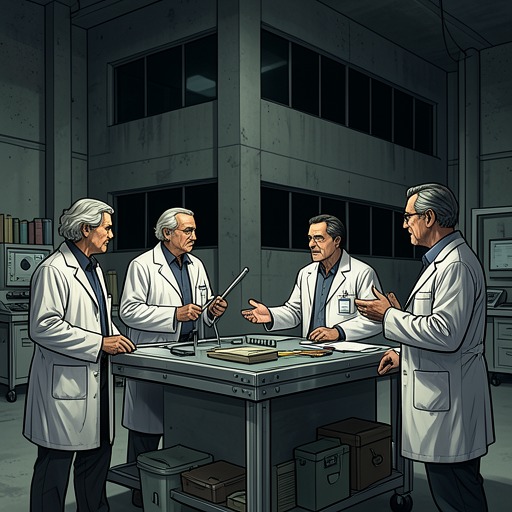
Nambodri counters that even a very small mathematical possibility can justify searching for truth. Their dispute is not simply whether extraterrestrial life is possible. It concerns which methods and questions deserve institutional resources, and who has authority to define science. Nambodri raises the Giant Ear issue in front of other scientists, arguing that the Balloon Mission is not the only work the Institute should support and that Acharya has unfairly blocked the search for extraterrestrial intelligence. Acharya’s own interest in life beyond Earth therefore does not make him an advocate for every alien-life investigation: he rejects radio SETI while pursuing a biological account of life’s movement between planets.
The Balloon Mission and the limits of its result
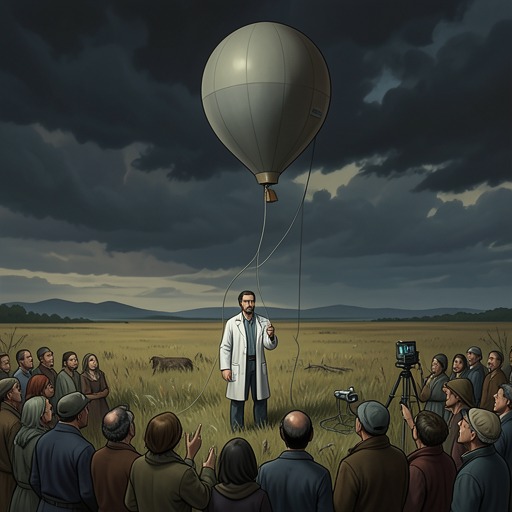
The Balloon Mission gives the theory its most consequential test. Under Acharya’s direct supervision, a hot-air balloon launched from the Hyderabad balloon launch site carries four sterilized samplers, designed to open by remote control at a chosen altitude. The devices capture air at 41 kilometres, a height at which the stated purpose of the mission is to investigate whether life is present. Two samplers go to Cardiff and one to Boston for study; the remaining sampler is examined at the Institute’s Astrobiology lab by Oparna’s team and two American scientists. Their work takes place in isolation, with little communication to the rest of the Institute.
When the team emerges with its findings, Oparna holds a bundle of handwritten papers bound with cord. The conclusion reports a rod-like bacillus and the fungus Engyodontium albus de Hoog at 41 kilometres. The discovery is announced as evidence that living cells exist at that altitude, and Acharya is described as the first person to discover aliens. The more careful account, however, preserves a distinction between finding life there and proving where it originated. Asked why he thinks the organisms came from space, Acharya says he has not concluded that they did: extraterrestrial origin is a reasonable guess supported by several facts.
Those facts are suggestive, not decisive. It had been believed that bacteria and fungi could not exist at such heights; contamination by debris from defunct satellites is described as very unlikely; and the discovered organisms are said to be rare and difficult to culture in laboratory conditions. Acharya also stresses the importance of preventing contamination before and after the mission. The concern is not abstract: if sterilizing the cryogenic sampler is difficult, he reasons, spacecraft may be vulnerable too, and missions to the Moon and Mars may have left Earth microbes behind. The possibility of contamination thus complicates the interpretation of extraterrestrial life in both directions: a signal from another world might be Earth life transported there, while cells found high above Earth might still have an explanation other than cosmic arrival.
Public meaning and narrative significance
The discovery changes the status of Acharya’s idea without resolving its central uncertainty. The novel says the result supports the theory that life on Earth first arrived as microscopic organisms from space, and that the boundary between alien and terrestrial life has become blurred. But the press briefing’s language remains conditional: the origin is a reasonable guess, not a demonstrated fact. Cosmic Ancestry Theory consequently gains force through evidence that invites a larger interpretation, while the gap between observation and explanation remains visible.
Its public presentation also turns a technical result into a claim with consequences beyond the laboratory. The Institute’s press officer explains the altitude, the four samplers, and the division of samples among laboratories, while raising the possibility that sudden diseases such as SARS might be extraterrestrial in nature. That possibility is presented as a question the discovery reopens, not as a finding established by the sampler. Acharya’s own response is more exuberant: after the news, he tells the press officer that humanity has been living with aliens and imagines that aliens may have used aliens to make curd. The comic leap gives public expression to the theory’s unsettling implication—that the categories of native and foreign life may not hold as securely as people assume—without substituting a joke for scientific proof.
The theory also gives the novel a contrast between two kinds of scientific boundary-making. Acharya dismisses the Giant Ear’s search for signals as anthropomorphic speculation, yet treats the discovery of high-altitude organisms as evidence that may support a cosmic origin of life. In both disputes, scientific authority depends on how a possibility is framed, what evidence is considered adequate, and who controls the Institute’s resources and public account. Cosmic Ancestry Theory is therefore more than a proposed origin story: it is a biological hypothesis whose apparent confirmation intensifies, rather than ends, the novel’s questions about proof, contamination, and the limits of human knowledge.